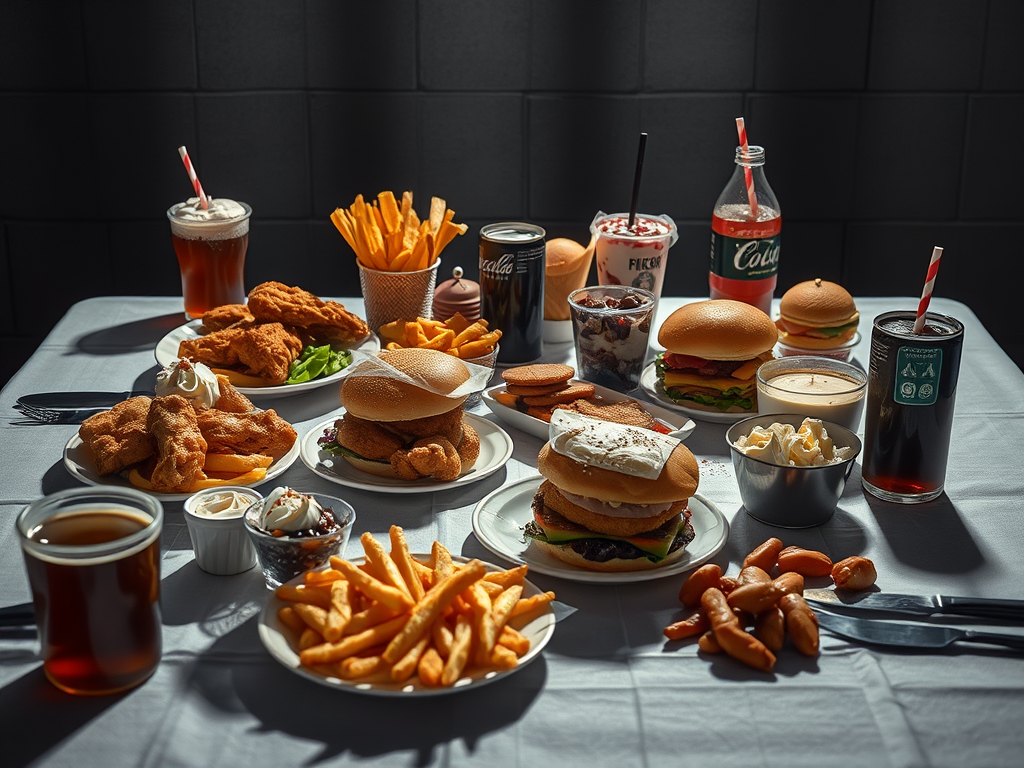
As Americans, we eat like…
…the future doesn’t matter.
A 2012 study entitled “Death Row Nutrition: Curious conclusions of last meals” found that the nutritional content of final meals chosen by death row inmates were akin to the Standard American Diet. An overall calorie count 2.5 times the recommended amount.
Deep Dive
Adapted from ChatGPT prompt responses,
“Death?row?nutrition.?Curious conclusions of last meals” by Brian?Wansink, Kevin?M.?Kniffin and Mitsuru?Shimizu. It was published in the journal Appetite (Vol.?59, Issue?3, December?2012, pp.?837–843)
https://pubmed.ncbi.nlm.nih.gov/22925848/#:~:text=Abstract
Why it was conducted
Wansink and colleagues noted that many anecdotes about death row last meals exist, but no systematic analysis had been done. They hypothesized that a final meal gives insight into “true consumption desires” when future consequences no longer matter.
Methods and data
- Dataset – They compiled a database of final meal requests from 247 U.S. inmates executed between 2002 and 2006. CBS News reports that the researchers focused on 193 meals. They excluded 51 inmates who declined a last meal. They also excluded three with extremely low calorie requests. The sample was overwhelmingly male (all but two) and averaged 43?years of age
- Analysis – They estimated the caloric and nutritional content of each requested meal and coded foods by category. Requests were treated as indicators of the inmates’ preferences and “true consumption desires” when the future has little value pubmed.ncbi.nlm.nih.gov.
Key findings
- Calorie content – The average last meal contained approximately?2,756?calories, about 2.5?times the daily recommended servings of protein and fat for an adult pubmed.ncbi.nlm.nih.gov. Four of the meals exceeded 7,200?calories cbsnews.com.
- Food categories – High calorie comfort foods dominated. Meat was requested in 83.9?% of meals; fried foods in 67.9?%; desserts in 66.3?%; and soft drinks in 60?%pubmed.ncbi.nlm.nih.gov. A separate summary noted that French fries (40.9?%) and other potato sides (20.7?%) were the most common starches, with bread (17.1?%) next, while pasta and rice were each requested by only three inmates psmag.com. Twothirds of meals included dessert, typically ice cream (24.3?%), pie (23.8?%) or cake (16.1?%) psmag.com. About a quarter of inmates (26.9?%) requested salad psmag.com.
- Brand names – Roughly 39.9?% of inmates asked for branded foods or beverages pubmed.ncbi.nlm.nih.gov. Only 4?% asked for fast food takeouts like McDonald’s or KFC riotfest.org, and sugar sweetened beverages were favored over milk fivetoone cbsnews.com; Diet?Coke was requested three times psmag.com.
- Interpretation – The authors suggested that these findings fit a model of “environmentally contingent temporal discounting”. When faced with imminent death, people favor immediate pleasure. People focus on immediate enjoyment. They choose high-calorie comfort foods.pubmed.ncbi.nlm.nih.gov. Such behaviour parallels findings that stress and mortality salience can lead to overeating pubmed.ncbi.nlm.nih.gov.
Followup research
A subsequent study by Kevin?Kniffin and Brian?Wansink, “Death Row Confessions and the Last Meal Test of Innocence” (Laws,?2014), extended the analysis. That study found that inmates who denied guilt were 2.7?times more likely to decline a last meal and, when they did request one, ordered 34?% fewer calories than those who confessed sciencedaily.com.
Conclusion
“Death?row?nutrition” provides one of the first empirical looks at the foods requested by condemned inmates. Wansink and colleagues cataloged nearly 200 last meals. They showed that when the future is discounted to near zero, people overwhelmingly choose calorie-dense, familiar comfort foods. This offers insight into how stress and mortality salience can shape eating behavior pubmed.ncbi.nlm.nih.gov.

One response to “As Americans, we eat like… ”
-
oh yeah

Disclaimer: GutBrain does not offer medical care or medical advice. Ever. GutBrain provides information to share and discuss with your private physician and medical care providers.
Leave a Reply